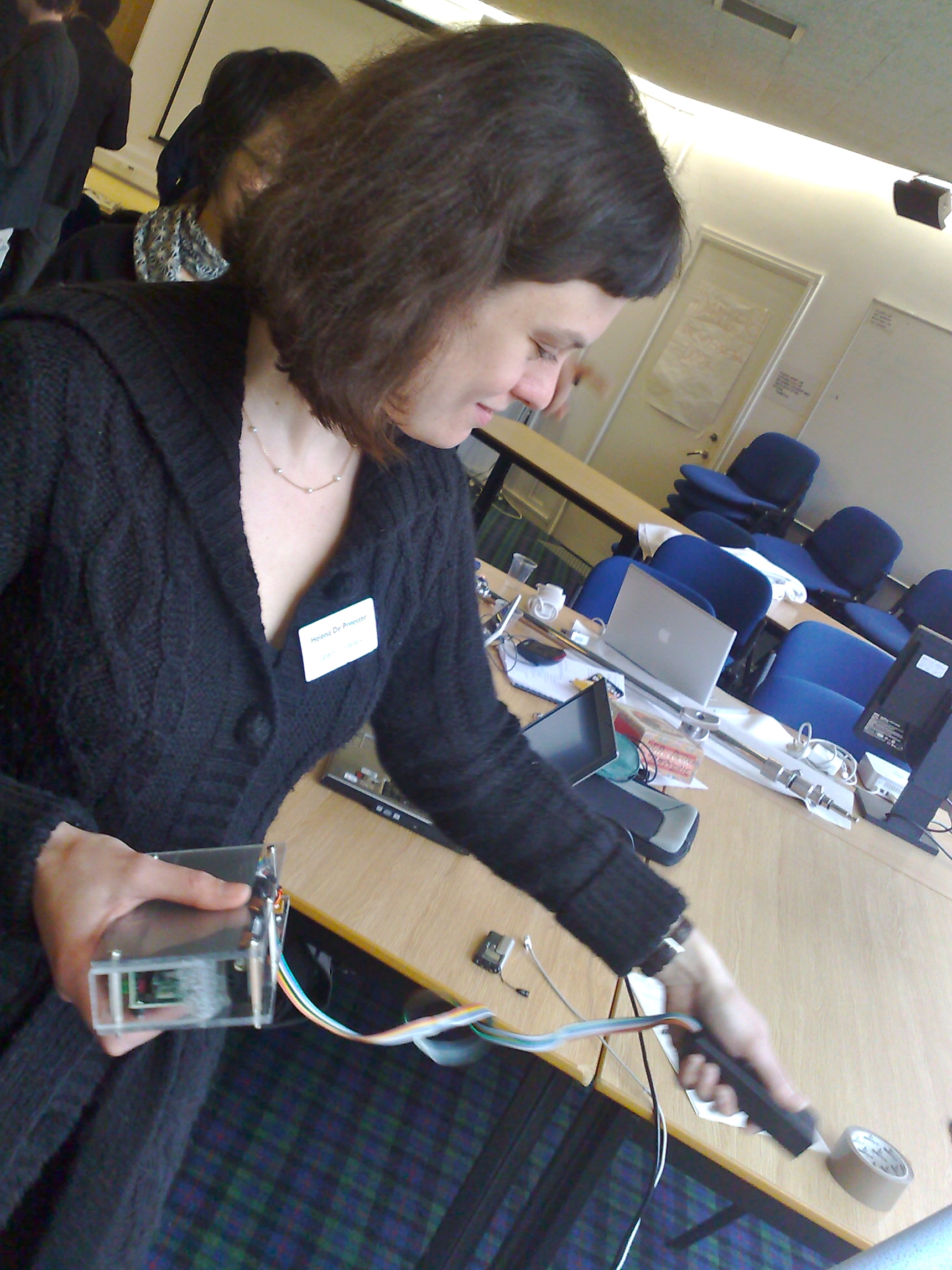
 Helena de Preester using the Enactive Torch
On Thursday the 26th and Friday the 27th of March, 2009, the
e-sense project hosted the
Key Issues in Sensory Augmentation Workshop at the University of Sussex. I was invited to speak at the workshop; my position statement (included below) serves as a good (if long) summary of my talk.
Media:
Sensory Augmentation, Synthetic Phenomenology & Interactive Empiricism: A Position Statement
How can empirical experiments with sensory augmentation devices be used to further philosophical and psychological enquiry into cognition and perception?
The use of sensory augmentation devices can play a crucial role in overcoming conceptual roadblocks in philosophy of mind, especially concerning our understanding of conscious experience and perception. The reciprocal design/use cycle of such devices might facilitate the kind of conceptual advance that is necessary for progress toward a scientific account of consciousness, a kind of advance that is not possible to induce, it is argued, through traditional discursive, rhetorical and argumentative means.
It is proposed that a philosopher's experience of using sensory augmentation devices can play a critical role in the development of their concepts of experience (Chrisley, Froese & Spiers 2008). The role of such experiences is not the same as the role of say, experimental observation in standard views of empirical science. On the orthodox view, an experiment is designed to test a (propositionally stated) hypothesis. The experiences that constitute the observational component of the experiment relate in a pre-determined, conceptually well-defined way to the hypothesis being tested. This is strikingly different from the role of experience emphasized by interactive empiricism (Chrisley 2010a; Chrisley 2008), in which the experiences transform the conceptual repertoire of the philosopher, rather that merely providing evidence for or against an empirical, non-philosophical proposition composed of previously possessed concepts.
A means of evaluation is need to test the effectiveness of the device with respect to the goals of interactive empiricism and conceptual change. Experimental philosophy (Nichols 2004) looks at the way in which subjects' philosophical views (usually conceived as something like degree of belief in a proposition) change as various contingencies related to the proposition change (e.g., how does the way one describes an ethical dilemma change subjects' morality judgements of the various actions in that situation?; cf, e.g. (Knobe 2005)). One could apply this technique directly, by empirically investigating how use of sensory augmentation devices affect subjects' degree of belief in propositions concerning the nature of perceptual experience. However, it would be more in keeping with the insights of interactive empiricism if such experiments measured behaviour other than verbal assent to or dissent from propositions, such as reaction times and errors in classification behaviour. This might allow one to detect changes in subjects' conceptions of the domain that are not reportable or detectable by more propositional, self-reflective means.
Are there rigorous techniques that can characterise the subjective experience of using sensory augmentation technology?
Synthetic phenomenology is 1) any attempt to characterize the phenomenal states possessed, or modelled by, an artefact (such as a robot); or 2) any attempt to use an artefact to help specify phenomenal states (independently of whether such states are possessed by a naturally conscious being or an artefact) (Chrisley 2009; Chrisley 2010b; Chrisley 2008). Although "that" clauses, such as “Bob believes that the dog is running”, work for specifying the content of linguistically and conceptually structured mental states (such as those involved in explicit reasoning, logical thought, etc.), there is reason to believe that some aspects of mentality (e.g., some aspects of visual experience) have content that is not conceptually structured. Insofar as language carries only conceptual content, “that” clauses will not be able to specify the non-conceptual content of experience. An alternative means, such as synthetic phenomenology, is needed.
Earlier (Chrisley 1995), I had suggested that we might use the states of a robotic model of consciousness to act as specifications of the contents of the modelled experiences. This idea has been developed for the case of specifying the non-conceptual content of visual experiences in the SEER-3 project (Chrisley and Parthemore 2007a; Chrisley & Parthemore 2007b). Specifications using SEER-3 rely on a discriminative theory of visual experience based on the notion of enactive expectations (expectations the robot has to receive a particular input were it to move in a particular way). Depictions of the changing expectational state of the robot can be constructed in real time, depictions that require the viewer to themselves deploy sensory—motor skills of the very kind that the theory takes to be essential to individuating the specified content. Thus, the viewer comes to know the discriminating characteristics of the content in an intuitive way (in contrast to, say, reading a list of formal statements each referring to one of the millions of expectations the robotic system has).
Just as SEER-3 models, and permits the specification of, experiences in a modality we naturally possess (vision), so might other robotic systems, equipped with sensors that do not correspond to anything in the natural human sensory repertoire, model and permit the specification of other experiential states. As with the case of visual experience, specification cannot consist in a mere recording or snapshot of the sensor state at any moment, nor even in a sequence of such snapshots. Rather, the specification must be dynamically generated in response to the specification consumer’s probing of the environment (virtual or real), with the sensor values being altered in a way that compensates for both the subjectivity of the experience being specified, and that of the recipient herself.
References:
- Chrisley, R. (2010a, in press). "Interactive empiricism: the philosopher in the machine, in: McCarthy, N. (ed.), Philosophy of Engineering: Proceedings of a Series of Seminars held at The Royal Academy of Engineering. London: Royal Academy of Engineering. http://www.sussex.ac.uk/Users/ronc/papers/interactive-empiricism.pdf
- Chrisley, R. (2010b, in preparation) "Synthetic phenomenology". Scholarpedia. http://www.scholarpedia.org/article/Synthetic_phenomenology.
- Chrisley, R. (2009) "Synthetic Phenomenology", International Journal of Machine Consciousness 1:1. http://www.sussex.ac.uk/Users/ronc/papers/synthetic-phenomenology-ijmc.pdf
- Chrisley, R. (2008) "Philosophical foundations of artificial consciousness". Artificial Intelligence In Medicine 44:119-137. doi:10.1016/j.artmed.2008.07.011; http://www.sussex.ac.uk/Users/ronc/papers/phil-founds-artificial-consciousness.pdf
- Chrisley, R. Froese, T., Spiers, A (2008) "Engineering conceptual change: The Enactive Torch" Abstract of talk given November 11th, 2008, at the Royal Academy of Engineering as part of the 2008 Workshop on Philosophy and Engineering http://www.sussex.ac.uk/Users/ronc/e-asterisk/WPE2008-Chrisley.pdf
- Chrisley, R. and Parthemore, J. (2007a) "Robotic specification of the non-conceptual content of visual experience". In Proceedings of the AAAI Fall Symposium on "Consciousness and Artificial Intelligence: Theoretical foundations and current approaches". AAAI Press. http://www.consciousness.it/CAI/online_papers/Chrisley.pdf
- Chrisley, R. and Parthemore, J. (2007b) "Synthetic phenomenology: Exploiting embodiment to specify the non-conceptual content of visual experience". Journal of Consciousness Studies 14 pp. 44-58. http://www.sussex.ac.uk/Users/ronc/papers/ChrisleyandParthemore-SyntheticPhenomenology.pdf
- Chrisley, R. (1995) "Taking Embodiment Seriously: Non-conceptual Content and Robotics," in Ford, K., Glymour, C. and Hayes, P. (eds.) Android Epistemology. Cambridge: AAAI/MIT Press, pp 141-166. http://www.sussex.ac.uk/Users/ronc/papers/ae-embodiment.pdf
- Knobe, J. (2005). "Theory of Mind and Moral Cognition: Exploring the Connections", Trends in Cognitive Sciences 9, pp 357-359.
- Nichols, S. (2004). "Folk concepts and intuitions: From philosophy to cognitive science", Trends in Cognitive Sciences 8:11, pp 514-518.